Argonav gives inland skippers centimetre-accurate bridge clearance.
The argoBridgePilot turns vessel height, the measurement standard GNSS handles worst, into a safety-critical warning. It works only if the height stays accurate the whole way and never goes dark, which is where we come in.
Summary
Argonav, a Stuttgart-based navigation-systems maker and part of the Alphatron Marine group, builds the argoBridgePilot, a bridge-strike warning system for inland vessels. Its premise rests on knowing a vessel’s height to the centimetre, in real time, as loading and water levels shift, a measurement ordinary GNSS handles poorly.
By integrating RTK Premium, Argonav gets survey-grade height that stays stable and homogeneous along the whole route, from a Network RTK (NRTK) stream that also stays live even if one source drops, so the safety warning never goes dark. The result: skippers are alerted before a bridge that is too low, regardless of weather, darkness or river bends.
The partner
Argonav develops innovative solutions for inland navigation, integrating radar and lidar technologies into modern electronic chart display and information systems (Inland-ECDIS), with a focus on user-centric software tailored to inland shipping.
Based in Stuttgart and part of the Alphatron Marine group, it brings more than 20 years’ experience to the bridges of commercial vessels working Europe’s rivers and canals. Its flagship argoRadarPilot anchors a product family that includes the argoBridgePilot, the argoLaserPilot and the argoCharts chart package.
The people who rely on Argonav’s software are inland skippers and crews, making continuous, high-stakes judgement calls about where a vessel can safely go, often in poor visibility, at night, and on winding waterways where the next obstacle is not yet in sight.
The challenge
For an inland vessel, clearing a bridge is a matter of centimetres. The margin depends on the boat’s exact height above the water, which changes constantly with cargo, loading and squat, set against a bridge clearance that itself moves with the water level. Traditionally, crews judge that margin from experience, charts and eyesight, which gets harder at night, in bad weather, and around bends where the bridge appears late.
An automated warning system is the obvious answer, but it runs into a hard limit: standard GNSS receivers are least accurate in exactly the dimension that matters most here, height, where errors run to metres.
For a safety-critical clearance call, that is far too coarse. And a warning is only as dependable as the corrections behind it: a dropout at the wrong moment leaves a crew with no warning at all. The single most important measurement was the one conventional positioning could not deliver, reliably.
Survey-grade height, stable and always live
A bridge-strike warning cannot afford a blind moment. If the correction stream falters, the height fix loses the centimetre precision the whole warning depends on. So the decisive factor was not accuracy alone, but corrections that stay live.
A bridge-strike warning is only as good as the height behind it, and not just at one spot but the whole way along a route. We produce Network RTK (NRTK) corrections across a network of reference stations, so precision stays stable and homogeneous everywhere, rather than degrading with distance to a single base the way simple RTK does. For the long runs an inland vessel makes, that means survey-grade height that holds from one end of the journey to the other, and the altitude, the measurement that matters most here, is far more reliable than single-base RTK can offer.
It also has to stay live. We run a multi-service correction network with no single point of failure, switching seamlessly between independent sources, so if one drops, the fix stays live, with 99.98% network uptime behind it. For a safety-critical function on the water, stable precision and uninterrupted corrections are what separate a system crews trust from one they second-guess.
Argonav integrates RTK Premium into the argoBridgePilot, and the platform gives it a single portal view: licenses kept separate from devices, a live picture of which vessels are using what, and provisioning and reordering in one place. Subscription terms that flex from a single week to multi-year let it match how differently each operator runs.
The solution in practice
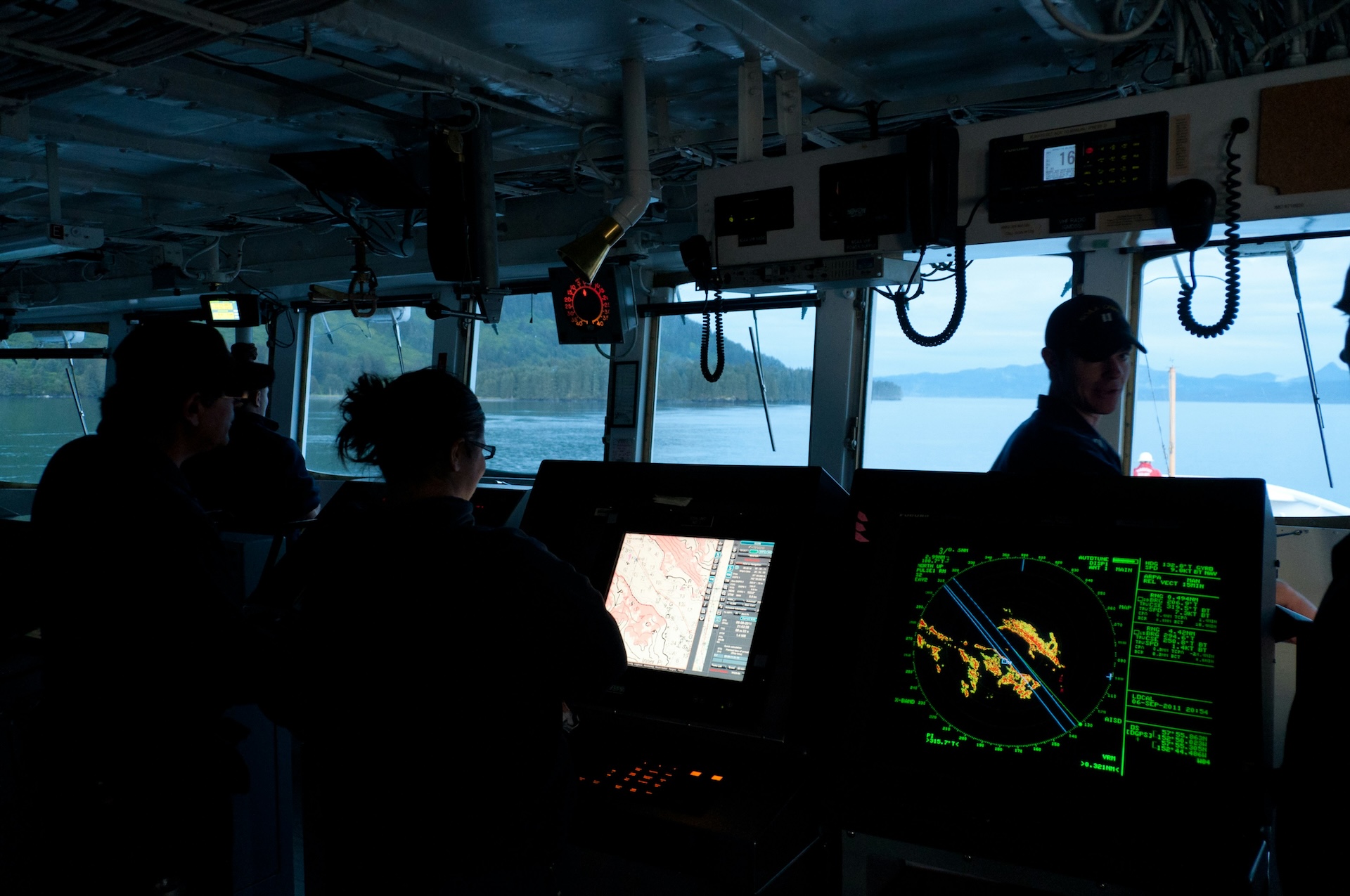
On a typical voyage, the argoBridgePilot continuously measures the geodetic height of the wheelhouse roof, and optionally other structures such as the radar mast, using a live RTK-GNSS fix corrected to a few centimetres. Because it reads the true height above the geoid in real time, the effects of water level and the vessel’s current loading and squat are already part of the measurement, with nothing for the crew to enter by hand.
That fix is fed by our Network RTK (NRTK) stream, so precision stays stable along the whole route and a single base or network dropping does not interrupt the measurement. The system compares the live height against the clearance of every bridge within range, drawing on chart data and on current Notices to Skippers so that temporary height restrictions and bridge works are taken into account. It watches all bridges in the warning zone at once and flags the first critical one, giving an optical and acoustic warning well ahead, and escalating to an alarm only when there is an immediate risk of collision, independent of weather, daylight, sightlines or how the waterway bends.
Crucially for a cramped wheelhouse, there is no extra screen. The argoBridgePilot’s display is built into the argoRadarPilot Inland-ECDIS: bridges are colour-coded on the chart for passable versus collision-risk zones, with precise clearance shown both numerically and schematically, right in the skipper’s field of view. Argonav integrates RTK Premium and provisions and monitors corrections for its vessels from a single portal view, with licenses managed separately from the units they run on.
The results
- The decisive measurement, height, is survey-grade and stays stable along the whole route instead of degrading with distance to a base, turning the obstacle that blocked a GNSS-based solution into the system’s foundation.
- The correction stream stays live through base or network dropouts, so there are no blind moments in a safety-critical warning.
- 99.98% network uptime underpins continuous operation, day and night.
- Argonav integrates RTK Premium and manages corrections, licenses and devices for its fleet from a single portal view.
- Flexible plan terms match how differently each vessel operates, from occasional trips to constant service.
- Warnings no longer depend on weather, daylight, visibility or river curvature, with water level, loading and squat handled automatically in the live measurement.
- No added hardware or extra monitor: the warning sits inside the existing ECDIS chart, with at least a month of on-board logging and optional argoCloud review.
Support when it counted
Argonav has been candid with us, which is exactly what a working partnership needs. As it extended coverage into Eastern Europe, its team flagged a positioning issue traced to the geo-fence function, alongside a question on pricing.
We took the case, resolved the behaviour, and revisited the commercial terms on Argonav’s most recent order. Closing the loop on both the technical fix and the pricing is what turns a frank review into a stronger relationship.

One source of RINEX, anywhere you operate.
Connect your hardware profile.