RTK corrections in Arizona
RTK Premium delivers network RTK corrections in Arizona in NAD83(2011), epoch 2010.0, over standard NTRIP. In a fixed solution it reaches under 1.5 cm horizontally and 2.5 cm vertically. It costs $900 per device per year, or $690 for RTK Core on a single network, and a 14-day free trial comes first. Much of northeastern Arizona has no RTK Premium network today, so check each site on the coverage map.
RTK Premium in Arizona
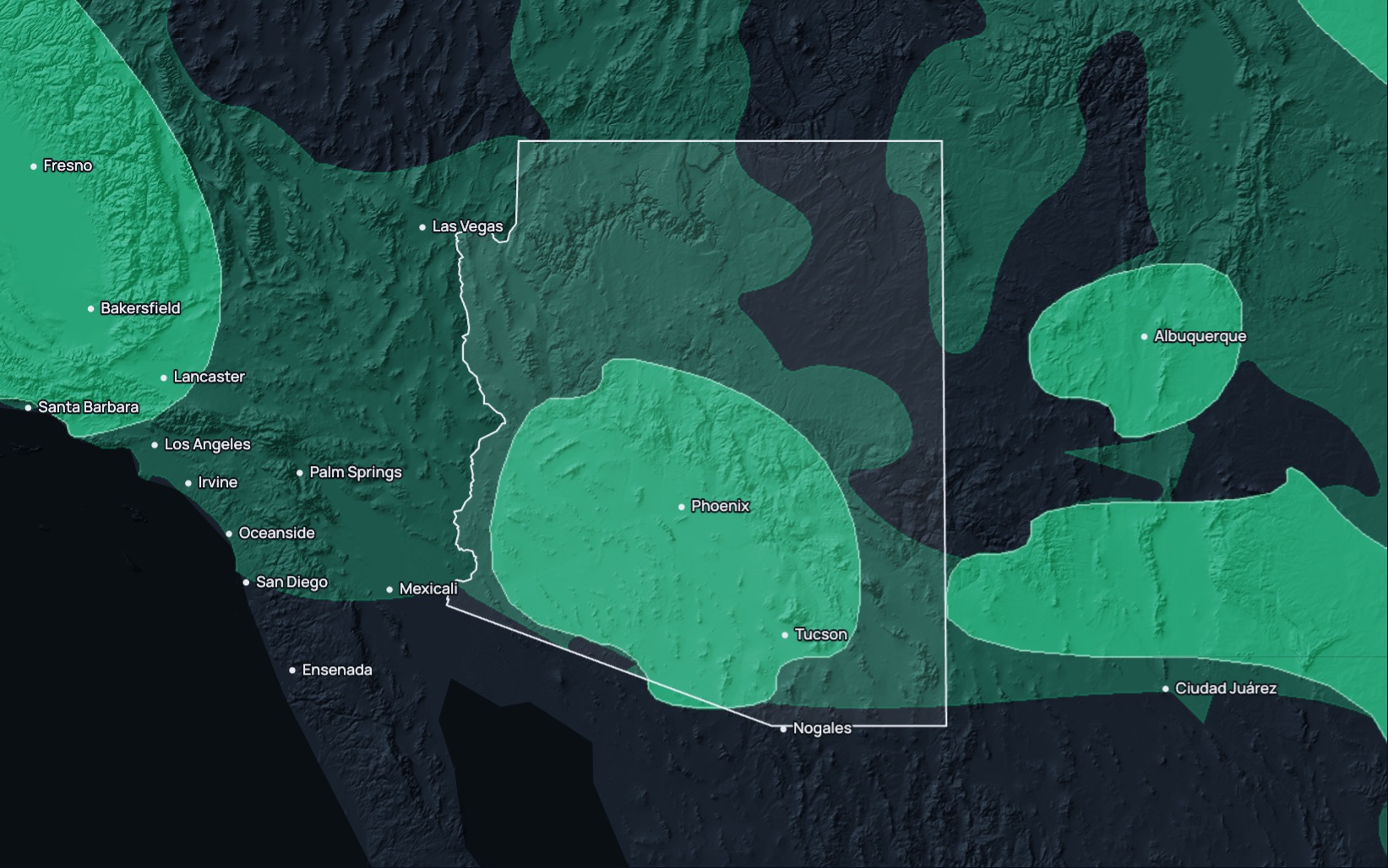
| Coverage | The coverage map shows networks over about 81% of Arizona's land area: 2+ networks across much of central and southern Arizona, 1 network across much of northern Arizona, and no network across much of northeastern Arizona; check your site for 1 network or 2+ networks |
|---|---|
| Frame | NAD83(2011), epoch 2010.0; ITRF on request |
| Accuracy | Under 1.5 cm horizontal, 2.5 cm vertical, in a fixed solution |
| Service level | 99.9% monthly availability for RTK Premium where the coverage map shows an Eligible Area |
| Trial | 14 days on your own receiver; your account arrives by email within two working hours |
| Price | In the US, RTK Premium costs $900 per device per year, RTK Core $690 and RTK Access $350, excluding sales tax. Monthly plans run from $39 to $100. |
| Support | Business days, 01:00 to 15:00 Mountain Standard Time in winter and 00:00 to 14:00 in summer, as Arizona keeps its clocks (09:00 CET to 17:00 ET) |
| Stream | RTCM 3.x over NTRIP; caster rtkpremium.xyz, port 2101, mountpoint COMMON |
Check it before you commit
Setup guides
More than 100 step-by-step guides cover receivers, controllers, drones and machine control.
Test it yourself
RTKTEST.com compares up to three correction services against a surveyed point in one 15-minute session, and the 14-day trial runs on your own receiver at your own sites.
Correction services in Arizona
Arizona crews choose between a state agency's CORS network, commercial network RTK, crowd-sourced base stations, satellite-delivered corrections and their own base.
| Type | Typical operator | What to check |
|---|---|---|
| State CORS network | A state agency, which distributes a real-time stream in NAD83(2011), epoch 2010.0, to public agencies, private users and the public after registration. | Registration terms, coverage near your sites, whether an availability commitment is published, and support hours. |
| Commercial network RTK | A private provider with stations across several states. | How many correction sources serve your area, the published service level and its remedy, and the term. |
| Crowd-sourced network | Independent owners hosting single base stations. | Distance to the nearest base, station uptime, and how each base was surveyed. |
| Satellite or state-space (PPP-RTK, SSR) | A provider broadcasting an error model without a local base. | Convergence time, accuracy and vertical performance. |
| Your own base | Your crew, on a surveyed point. | The survey of the base point, range, and the time spent setting it up and guarding it. |
Coordinates and heights
RTK Premium delivers NAD83(2011), epoch 2010.0, on every Arizona connection, and ITRF on request. Arizona uses three State Plane zones under NAD83: East, Central and West. The state agency's CORS network uses the same frame and epoch for its station coordinates, which helps when a job ties into its stations. Set the project, the controller and the correction service to the same frame and zone before the job starts.
Setup
- Start the 14-day free trial on this site, or order a subscription. Your account arrives by email within two working hours.
- Enter the caster rtkpremium.xyz, port 2101 and mountpoint COMMON in your controller or receiver, with the username and password from your account.
- Measure a control point you trust before the job starts, and compare the result with its published coordinates in your project's frame.
Industries using precise positioning or RTK corrections in Arizona
Lettuce: Arizona growers harvested 24,700 acres of romaine and 27,000 acres of head lettuce in 2025, and the head lettuce crop reached 10,395,000 hundredweight. Bed shaping, planting and thinning on those fields run on guidance lines that have to repeat row for row. (USDA NASS, State Agriculture Overview, 2025)
Roads: Arizona had 76,079 miles of public road in 2024, and federal agencies were responsible for 14,088 of its 44,262 rural miles. Grading, drainage and resurfacing on those roads are staked and checked against design. (FHWA, Highway Statistics, Table HM-10, 2024)
Housing: Arizona's 2025 building permits cover 33,371 new single-family homes and 16,691 units in buildings of five or more units. Lots, utility runs and building pads in those developments are staked out before the first foundation goes in. (U.S. Census Bureau, Building Permits Survey, 2025)
Power plants: Arizona's power plants had a net summer capacity of 32,877 megawatts in 2024, and natural gas was the primary energy source. Solar farms, substations and transmission routes are laid out from surveyed points. (U.S. Energy Information Administration, 2024)
Questions about RTK in Arizona
Which RTK correction service serves Arizona?
RTK Premium serves Arizona with network RTK in NAD83(2011), epoch 2010.0, and much of northeastern Arizona has no RTK Premium network today. The coverage map shows where 1 network and where 2+ networks serve a site.
Is there a free RTK network in Arizona?
A state agency runs a statewide CORS network and distributes its real-time stream to public agencies, private users and the public after registration. Check its coverage near your sites and what it commits to on availability and support before you rely on it for paid work.
How much does RTK cost in Arizona?
RTK Premium costs $900 per device per year, RTK Core $690 and RTK Access $350, with monthly plans from $39 to $100, excluding sales tax.
Which reference frame and zone do I use in Arizona?
RTK Premium delivers NAD83(2011), epoch 2010.0, with ITRF on request. Project the coordinates into the Arizona State Plane zone for your site, East, Central or West.
Does RTK Premium cover northern and northeastern Arizona?
The coverage map shows 1 network across much of northern Arizona and no network across much of northeastern Arizona. Much of central and southern Arizona shows 2+ networks, so check each northern site before you plan a job.
How accurate is RTK in Arizona?
In a fixed solution under good conditions, RTK Premium reaches under 1.5 cm horizontally and 2.5 cm vertically.
Can I try it before I buy?
Yes. The 14-day free trial runs on your own receiver and needs no payment.
Last updated: 12 November 2026
Try RTK Premium in Arizona
Run the 14-day trial at your own Arizona sites, in your own State Plane zone, before you commit to a plan.